By U Gourmat Kitchen · July 15, 2025 · 3 min read
A sharp knife is a safe knife. Dull blades require more force, slip more easily, and produce uneven cuts. Sharpening your own knives with a whetstone is a skill every home chef should master — it gives you complete control over the edge and saves money on professional sharpening. Here is how to do it.
Why a whetstone?
Whetstones offer precise control over the sharpening angle and grit progression. Unlike pull-through sharpeners that remove too much metal and create inconsistent edges, a whetstone lets you tune the edge exactly to your needs. An aluminum oxide whetstone kit with 1000/6000 grit covers everything from reshaping a dull edge to polishing a razor finish.
Understanding grit
Whetstones come in different grits. Lower numbers are coarser and remove more metal. Higher numbers are finer and polish the edge.
- 400-800 grit: For repairing chipped or severely dull blades
- 1000 grit: For routine sharpening of a dull knife
- 3000-6000 grit: For polishing and refining a sharp edge
For most home chefs, a 1000/6000 combination stone is all you need.
Preparing the stone
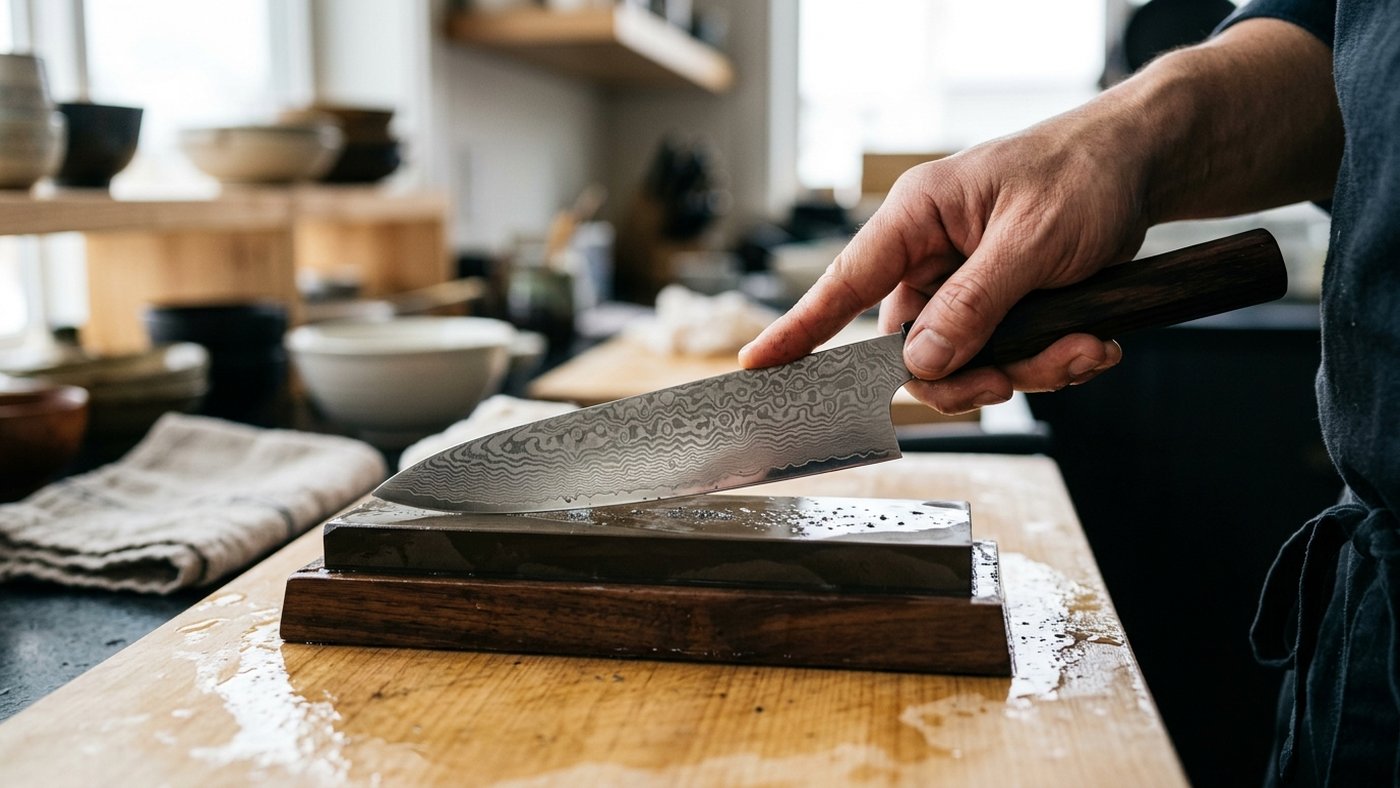
Soak the stone in water for 10-15 minutes before use. You will see bubbles stop rising when it is fully saturated. Place the stone on a damp towel to prevent it from sliding. If your kit includes an angle guide, attach it to the spine of your knife.
The sharpening angle
The ideal angle for most kitchen knives is 15-17 degrees per side. Japanese knives often use 12-15 degrees for a sharper, more delicate edge. Western-style chef knives typically use 17-20 degrees for a more durable edge.
Sharpening technique
Start with the 1000 grit side. Hold the knife at your chosen angle and draw the blade across the stone from heel to tip, as if slicing a thin layer off the surface. Maintain consistent pressure and angle. Do 10-15 strokes on one side, then switch to the other. Repeat until you can feel a burr along the entire edge.
Removing the burr
Once you have a burr, switch to the 6000 grit side. Use lighter pressure and the same motion. This polishes the edge and removes the burr, leaving a clean, razor-sharp finish. Finish with a few light strokes on a leather strop if you have one.
How often to sharpen
For a home chef who cooks daily, sharpen on the 1000 grit stone every 2-3 months. Use the 6000 grit side for a quick touch-up every 2-3 weeks. Hone with a honing rod before each use to realign the edge between sharpenings.
The bottom line
Sharpening with a whetstone takes practice, but it is the most effective way to maintain your knives. Start with a 1000/6000 combination stone, maintain a consistent 15-17 degree angle, and practice on an inexpensive knife first. Within a few sessions, you will be producing edges that slice through paper with no resistance.